Five O'Clock Somewhere

Welcome to Five O'Clock Somewhere, where it doesn't matter what time zone you're in; it's five o'clock somewhere. We'll look at rural life, especially as it happens in Rio Arriba County, New Mexico, cats, sailing (particularly Etchells racing yachts), and bits of grammar and Victorian poetry.

Tuesday, January 15, 2013

Dumbing down?


I know educators mean well, but have they really thought the issue out?

I recently ran across an “adaptation” of The Wind in the Willows that nearly made me throw up. Sentences were shortened and converted to simpler grammatical forms; shorter words were substituted for longer (and more poetic and more precise) words; and the text was rendered so flat and lifeless that I don’t believe any self-respecting third-grader would WANT to read it. The Wind in the Willows is ALREADY a children’s book, and so what if the language is a bit challenging? That didn’t stop the Harry Potter books from being devoured by millions of youngsters.

In fact, researchers have found that reading complex language such as Shakespeare’s causes the brain to become more active and engaged, while reading less complex language triggers much less brain activity. I have found with my own students that when I give them something complicated to read, they generally work harder and get more out of the work.

Yes, there are those who argue that giving students something difficult to read may frustrate them and make them give up on the struggle, to the point, even, of hating school and everything about it. Thus, books should be “dumbed down” to make them more accessible.

I disagree. I believe that giving students something challenging to read will give them a greater feeling of accomplishment when they discover it isn’t really “too hard” after all. And being bored with school work—rather than being frustrated with it—is a major reason students disengage with education and drop out of school.

Take, for example, this sentence from the original The Wind in the Willows:
“Believe me, my young friend, there is nothing—absolutely NOTHING—half so much worth doing as simply messing about in boats.”

And this from the adaptation:
“If you’re doing it in a boat, it’s the best time ever!”

Which of these is more likely to benefit a third-grader?

Labels: , , , , , ,

Saturday, March 19, 2011

Woo-hoo, new shoes!

The time of financial austerity is over ...

For the past few years, Pat and I have been operating on an austerity budget. Part of that program has meant that I haven't had much in the way of new clothes for a very long time -- we've been shopping at thrift stores for most clothes. But now, at long last, I have the first pair of actual new shoes that I have had in about five years. And they're magnificent: delightful little black numbers that fit my feet like gloves, but with just enough extra stretch that in really cold conditions I can wear a pair of wool socks underneath.

Especially over on Facebook, many friends, including old high-school classmates, have reveled in their shoes -- how many they have, the special virtues of each pair, the stylishness, the excitement of finding just the right pair. Now, I can join them.

Meanwhile, it's not just my feet but also my boat, Black Magic, that is enjoying the end of austerity. We came down to Elephant Butte Friday with the hope of sailing with Zorro as well as working on boats. As it turned out, it was too windy to sail. First, I helped Zorro with patching some cracks in Constellation's deck and re-rigging the outhaul, which had been fouling far too often. Then Pat joined Zorro and me at the mast-up storage lot where Black Magic is, and we replaced a lot of the rigging: backstay control, mainsheet, jib sheet, traveler (including some blocks and other hardware), jib tack, mast block shock cords, and tiller tamer. Zorro also mixed up some epoxy filler, which he used to patch up some gouges in the keel as well as some dents in the deck.

Saturday, we had hoped that at least in the morning, we could get in some sailing; the weather forecasts predicted a breezy morning and a windy afternoon. But it was blustery from the get-go, much too windy for sailing. Zorro did some work on Constellation while Pat and I paid a visit to our favorite used-book store in the universe, Black Cat Books in Truth or Consequences. Gerald has a rule of thumb that a used-book store is not a proper used-book store unless there is a cat on the premises. I think I agree. Pat and I ended up getting a wide range of books, including a German grammar book, a collection of essays about what it means to be human in a technological environment, and a James Patterson (plus one of his more trustworthy co-authors, Maxine Paetro) thriller.

After that, Pat and I stopped by the hardware store to look for bolts to use when replacing the old cam cleats on the boat. In stainless steel, the longest bolts the store had were two inches, so we bought only four, two flathead and two pan-head, with the idea that whichever fit best, we could come back and buy more, and if neither fit, we weren't out much money.

Then Pat and I returned to Black Magic, where Pat set about working on replacing the old cam cleats on the console with the new ones that we had ordered. The old cleats were ancient and decaying even when we first got the boat, but we had never had time or money to replace them all -- when one of them failed, we put a new one in, and we kept saying that we needed to get them all replaced. It took Pat 20 minutes to remove just one cleat. We discovered that flathead bolts were the best for the new cam cleats, but two inches was too short -- we needed three-inch bolts.

Meanwhile, Zorro had done some more work on Constellation but had learned that the Sunday weather forecast was for even more wind, far too much to go sailing, so he decided to put his boat away and head back to El Paso. He stopped by Black Magic before heading south, and he and Pat worked on the shrouds -- we're looking at replacing turnbuckles at the very least and possibly at replacing the shrouds completely. We made plans to do more boat restoration next weekend, including new bottom paint at least on the parts of the keel that got patched. In the meantime, we can get the three-inch bolts and a few other bits of hardware we need. Top of the agenda for next weekend is completely redoing the outhaul on Black Magic so we can depower more effectively in a gust. There have been a lot of those lately.

Zorro is super-eager about all of these repairs and refurbishments, because he really, really wants to see Black Magic racing next weekend. And I do have to admit, I'm excited about seeing my boat finally getting back into a condition where she can sail well. But I'm feeling ambiguous about actually racing. I'm not sure I want to support the RGSC's current leadership -- the current commodore who, when he was vice commodore, tried to call meetings of the board even though the club constitution doesn't give him that power, and on shorter notice than even those who have the power are permitted to do; Zorro's replacement as race committee chairman to whom I gave the blog nickname "Space Invader" because of his creepy behavior toward me even before I learned of the New Mexico court records about him and the many restraining orders women have taken out against him; the club management that failed to notify one of our favorite restaurant owners that the sailing club was planning to hold a skippers' meeting in the restaurant's back room and thereby royally pissed off the restaurant owner ... I don't know that I want to race and thereby seem to support the current club leadership.

I think I'd rather just go sailing. And wear my new shoes.

Labels: , , , , , , , , , , , , , , ,

Monday, January 31, 2011

The good, the bad, and the ugly

Some thoughts about Home Owners Associations

Pat and I have been toying with the idea of buying a house of some sort in Arizona. Real estate prices in that state have plummeted, so there are a lot of good deals out there. The idea is that we would get a place close to ASU that Gerald could live in and that we could stay in when we go to visit him. By the time he graduates, property values will probably not have risen to the extreme levels they were at before the real-estate crash, but the house would likely have gained some value. At that point, we might sell at a profit, keep the place as a rental, or move into it ourselves – at least during the colder parts of the year. For summer, we’d retreat to Five O’Clock Somewhere up in the mountains.

Some of the properties we have looked at have been in neighborhoods where there is a Home Owners Association, or HOA. That can be a good thing, or it can be a bad thing, depending on the nature of the HOA in question. A good HOA will preserve or even enhance the value of the properties in the neighborhood, and it will provide a good return on residents’ dues in terms of services provided. A bad HOA can be a nightmare to deal with.

Among the HOAs associated with homes in Arizona, $100 a month seems to be about typical for dues. For that money, the HOA provides facilities and services, such as community swimming pools, tennis courts, open space, golf courses, clubhouses, and/or security. Some HOAs have lower dues, about $40 a month, and presumably the amenities provided are fewer as well.

And then there are the really bare-bones HOAs. We haven’t seen any of those in Arizona, but I was once on the board of an HOA that had one, and only one, function: to maintain and improve 7½ miles of private road leading into the neighborhood. No, I’m not on the board anymore, so I didn’t have anything to do with the current board’s disastrous decision to cut corners on costs by using cheaper gravel that turned out to be contaminated by millions of small nails, screws, and bits of wire. But back then, we were justifiably proud of our road. We heard many people call it “the best private road in Rio Arriba County,” and members of other HOA boards came to observe how we operated and how we managed to maintain the road with “only” $150 a year dues. (Dues have since been raised to $200 a year, but the board still manages to do a lot with very little – which lately has included paying for a lot of members’ tire repairs.)

Of course, services are only one side of the HOA issue. Many HOAs do more than provide services; they also have a say in what residents can or can’t do with their homes. This is seen primarily as a way to preserve property values; a neighbor’s activity will not negatively impact a place and reduce its desirability. These rules may be fairly loose, or they may be strict, and they typically apply to what can be stored in a house or yard, what activities can or can’t be done, what sort of landscaping is permitted, and changes to the house or other structures. The idea is that a person can buy a house in the neighborhood and not have to worry that the neighbors will disassemble junk cars in the front yard or paint their house vomit-green.

On the other hand, some HOAs rule with an iron fist. My brother Jer, of Muddled Ramblings, once lived in a neighborhood with a very strict and unreasonable HOA. He and his wife wanted to remodel the kitchen, but even though that remodeling wouldn’t impact the exterior of the house, it required approval of the HOA board. Another time, they wanted to replace a balky sliding glass door with an attractive French door at the back of the house. The board refused.

Jer’s neighbor had an even crazier run-in with the HOA. The neighborhood is on the edge of a canyon that is kept as a wilderness preserve in Southern California, where wildfires frequently sweep through in vast waves of destruction. The fire marshal had made an inspection of all local neighborhoods as part of an emergency-preparedness “triage” plan, and had declared that, in the event of a wildfire, this neighborhood was not savable, and that firefighting resources would be better focused elsewhere.

So the neighbor bought and installed a fire hose in front of his house. The HOA board went ballistic, ordering him to remove the eyesore immediately. He begged and pleaded and groveled, and eventually the board allowed him to keep the fire hose, under two conditions: that he keep it locked up at all times and that he not train anybody in how to use it.

The next fire season in Southern California was one of the worst on record. At one point, it seemed like all of San Diego County was on fire. Jer’s neighborhood was surrounded on three sides by wildfires. The neighbor broke out the fire hose and spent the next two days spraying water on all of the houses within reach. When the flames subsided, smoldering wreckage was all around, but Jer’s neighborhood survived. I never heard, though, whether the HOA board ate crow.

Meanwhile, back in Arizona, some HOAs seem to have more reasonable rules than others. It’s very typical to see rules on what color residents can paint their houses, restricting or forbidding parking of boats or RVs, or regulating landscaping.

There is one neighborhood in particular, where I would not want to live. The HOA has completely unreasonable restrictions, for example, on what colors house trim may be painted. If I want to paint my front door blue (a tradition in Northern New Mexico for good luck), I fail to see how that negatively impacts my neighbor’s property value, but blue is not on the list of permitted colors. That rule, however, is the least of the beefs with this particular HOA. The landscaping rules require that residents pretend they are not living in a desert. At least a certain percentage of the lot must be landscaped with water-hogging green grass (artificial turf is not allowed), and desert vegetation is forbidden, especially cacti. Saguaros are expressly prohibited.

That’s right, no saguaros allowed. In a neighborhood in Arizona. The saguaro blossom is the state flower. The majestic cactus itself is such an iconic symbol of the state that the very thought of Arizona brings to mind images of it, and it’s featured on state license plate. It amounts to heresy to prohibit an Arizona resident from having one as part of the landscape. If people don’t want to live where there are saguaros, they darn well shouldn’t live in Arizona, except perhaps in the northern part of the state that doesn’t have them.

On the other hand, there’s another neighborhood whose HOA’s rules are much more to my liking. Very few things are totally forbidden, although many do have to get approval of a special Architectural Compliance Committee appointed by the HOA board. This committee is very busy; it meets for two hours every other week. Depending on how reasonable members of the committee are, I might be able to live with it. For example, the HOA does have a list of approved colors that one can paint one’s house trim, but if a homeowner wishes to use another color, he or she can get permission from the committee. If I want to paint my front door blue, I can bring in a paint chip of the shade I want to use and explain how it will not detract from the appearance of the neighborhood, as well as the cultural background behind the color – this HOA seems to be very big on cultural heritage.

Other things that are forbidden outright by some HOAs are allowed in this neighborhood, again, with the approval of the Architectural Compliance Committee. Boats and RVs, clotheslines, auto maintenance, and more, are generally acceptable if they are not within view of adjacent properties or public areas, and if the means of shielding said view (shed, fence, or whatever) is approved by the committee. If the committee is reasonable about sheds, fences, and the like, I can live with that.

But the big thing that I really like about this HOA is its landscaping rules. This HOA understands the desert and respects it. Residents are encouraged to landscape with desert vegetation, especially species native to the Sonoran Desert, although other water-thrifty plants are allowed. The HOA has an extensive, detailed list, broken down by categories, of approved plants that a homeowner can plant. And yes, the saguaro tops the list in the “cactus” category. The HOA also has an extremely short list of forbidden plants that guzzle water, crank out vast quantities of pollen, or otherwise create a nuisance (palm trees over a certain height, pines, oleanders, junipers, and Bermuda grass). Any plant that is not on the approved list but not on that short list can be planted if – you guessed it – the Architectural Compliance Committee approves.

There is, however, one restriction on landscaping that I can’t quite figure out. Residents are not to have “unnecessarily unattractive shrubbery.” What the heck is that? I guess I can define “necessarily unattractive” shrubbery as, say, scrawny new plants that need time to fill out, or “unnecessarily attractive” plants as those that don’t have to be pretty but happen to be, while “necessarily attractive” shrubbery would be plants that can’t help being beautiful. But “unnecessarily unattractive”? My best guess would be something like obscene topiaries, but I’m not so sure. I guess I would have to ask the Architectural Compliance Committee.

Labels: , , , , , , , ,

Saturday, January 22, 2011

Parent or short order cook?

Which do you find more boring … this …


Or this?


Time and time again, I have heard parents complaining about how their kids are so picky about food – that they WILL NOT eat this or that or the other, or that they will only eat a select few foods that they trust and are not willing to experiment with anything beyond their range of familiarity. So, the parents moan, when the family goes out to eat, they have to go only to places that will serve what their kids like, and when the family is eating at home, the mom becomes a short-order cook, preparing one thing for one kid, another thing for another kid, separate from what the family as a whole is eating.

Pat and I never allowed Gerald to get picky – if he didn’t want to eat what we were eating, he didn’t eat. Funny thing is, he never really went through a picky stage, ever, and he has since taken not only to eating but also to cooking all sorts of intriguing foods. The gifted program at his elementary school ran a mini-restaurant that prepared a gourmet lunch every Wednesday as an alternative to the school cafeteria. He has also always enjoyed the cooking shows on television and been excited about the cooking techniques he has observed on them – at one point, he even considered being a chef as a career choice. Recently, he has become an expert on Vietnamese cuisine; one of his close friends is Vietnamese, and he’s now dating that friend’s kid sister.

Some years ago, my cousin, his wife and their two boys (then ages 9 and 5) came to visit us at Five O’Clock Somewhere. I tried to get the boys interested in helping in the kitchen – I was preparing chicken Kiev, (baked, not fried) so there were a lot of fun things to do such as pounding the chicken breasts with a mallet and using a rolling pin to smash crackers into crumbs. But they thought that whole idea was boring, especially the older one, opting instead to go to the living room and switch the television from the news that I was listening to, to an episode of Spongebob Squarepants that they had seen so often that they could recite all of the dialog in unison with the characters on the screen. Gerald and I ended up doing most of the work.

Then when we sat down to eat, the boys didn’t want to eat what was served, so their mother went into the kitchen to fix what they wanted – grilled cheese for one, a hot dog for the other. I was astonished that she caved in to their demands and that she would allow them to be so blatantly impolite to their hosts – as well as being somewhat impolite herself by presuming to go to the kitchen without checking in with me first (although that’s a gray area since I welcome people coming into my kitchen to help, and I enjoy what goes on when people who love each other are all cooking together. I have fond memories of Thanksgivings and Christmases when my mom, my aunt, Gerald, and I have all been cooking in harmony.)

Now, maybe my cousin’s wife decided that because we were family, she could go to the kitchen to do the short-order cook thing, and maybe in a more formal situation she would not allow her kids to snub the food that was served or presume to take over the kitchen herself. But I’m not so sure.

But then, I can’t really make my cousin and his wife (now ex, but still close to the family) out to be ultra-lenient, at least in today’s world. It seems that the vast majority of parents cater to their kids’ whims. At least daily, I encounter a parent who expresses frustration about her (or his) kid’s pickiness and laments all the time and trouble she has to go through to keep the kid satisfied. Usually it’s in an impersonal situation, such as a supermarket check-out line, where I can’t reasonably berate the parent for being so much of a wimp that she lets her kids walk all over her.

There was a television commercial that used to run often, featuring a mother and super-cute preschool-age daughter in a supermarket. The girl objected to everything the mother put into the shopping cart: “I don’t like chicken,” “I don’t like broccoli,” and so forth. In the end, the girl’s mother buys a sweet, vitamin-enriched milkshake-type product to make up for the nutrition the girl would miss by refusing to eat broccoli or chicken or anything else she doesn’t like. To me, that’s the ultimate cop-out. It provides a way for parents to say that they are making sure their kids’ nutritional needs are being met without having to make their kids angry with them, and it puts the kids in control of the family’s food-buying decisions.

Bullshit. Study after study has proved that the best way for the human body to absorb nutrients is to eat foods containing those nutrients, not to take a supplement that contains extracts of those nutrients or synthetic versions of them. Essentially, the nutritional milkshakes are simply a vitamin pill in liquid form. Kids may love them because of the flavor, and parents may love them because it keeps them from having to be the bad guy enforcing consumption of broccoli. Sorry, bad idea. Kids need to eat healthful food. It’s not just about the vitamins and minerals – which seems to be where parental concerns seem to reside. It’s about the overall healthfulness of the diet. A really caring parent will make sure his kid consumes healthful foods, no matter how much she protests.

Really, it’s simple. So long as the kid doesn’t have some underlying medical issue, it’s fine to let him refuse to eat what’s served. Eventually, he’s going to get hungry enough that he WILL eat it. Yeah, some highly principled individuals (such as Mahatma Ghandi) will go on hunger strike and risk death to make their point. But that sort of idealism is not what drives the average 9-year-old, so the kid’s determination will fade as the hunger increases. Refusing any food whatsoever may be child abuse, but offering only food that the child finds unpalatable is not.

Labels: , , , , , ,

Tuesday, August 31, 2010

The latest accusation of bias

Courtesy of The Onion ... possibly NSFW, depending on your workplace ...


In The Know: Are Tests Biased Against Students Who Don't Give A Shit?

I'm just waiting for TPTB to come down with edicts that there is yet another class of students that we need to make sure we don't discriminate against.

Labels: , , , ,

Tuesday, April 20, 2010

Academic dishonesty revisited

The technology war escalates

Last year, I wrote about discovering that I had had a visit to the blog on a search for a distinctive sentence from an earlier blog post, with quote marks around it, a common method used by teachers to ferret out academic dishonesty. At the time, I warned students not to attempt to copy something from the Internet to turn in as their own work, with the admonishment, "Don't even THINK about it. You WILL get caught!" – a standard warning I always issue to my students at the beginning of each term.

Still, this term, I have had two students who have attempted to turn in plagiarized papers. It's frustrating, and it really eats up a lot of my time to document the incidents and file all of the paperwork. The college where I teach requires that I report all incidences of academic dishonesty, no matter what. I consider this to be an excellent policy. I do not believe that academic dishonesty should be tolerated in any way, shape, or form. However, it eats up lots of my time, which, especially toward the end of the term, is a scarce commodity.

Part of the time-consuming aspect of documenting plagiarism is verifying that the work is plagiarized. This is usually done by doing an Internet search for distinctive phrases or sentences to find the original. The first student this term made the task time-consuming by pasting together material from four different sources. The second student, however, stymied me – every distinctive phrase I entered into the search engines turned up nothing. I knew the papers were plagiarized, and some other instructors who looked at them agreed – this was a student who couldn't put together a coherent sentence or develop a paragraph, and these were well written and well developed essays.

Then I discovered the latest online "service" provided to lazy students who just want to get a good grade rather than actually learning anything: plagiarism "prevention." These sites will allow a student to upload a paper, and then they will somehow modify it, changing words and phrases, and possibly making other adjustments, so that a teacher who does an Internet search on distinctive sentences will come up empty. The websites make such claims as "remove all plagiarism from your papers before you turn them in."

Bullshit. These websites don't remove plagiarism. They only disguise it. A paper is just as dishonest after being run through one of these websites as it was before.

And you know what? If you're a student and you turn in plagiarized material, even if you use one of these websites, you still WILL get caught. Even though I couldn't confirm an original Internet source for my student's essays, there were still enough glaring differences between this student's work and the plagiarized material that it was obvious. I just filed the report to the Dean of Students this afternoon.

Okay, I hear some students say … that was a student whose writing was really poor, so the plagiarism was blatant. What about students who write well enough that a plagiarized essay isn't going to be obvious? Well … if you're already writing so well that plagiarism won't be noticeable, then you don't need to plagiarize, do you? Your own writing will stand for itself. Don't cheat yourself out of an opportunity to hone your writing skills.

Labels: , , , , ,

Friday, February 05, 2010

The copier temptation

Oooooh, so close …

One of the tasks I find myself doing often at work is making copies. Sure, the community college where I work has a central copying service, but it has a couple of strikes against it. One is that it takes time to get documents processed, copied, and delivered to my mailbox, and I'm often printing things on short notice. The other is that, while it does offer a while-you-wait service, that service is only available limited hours of the day, and those hours don't include the hours that I'm usually on campus, since most of the classes I teach are evening classes.

This means that I have come to know the copiers in the faculty workrooms very well over the years. The one that was at the campus where I'm teaching this term was getting to be like an old friend – or sometimes a familiar adversary. I knew exactly which buttons to push, where the paper was likely to jam, how to run a butcher knife along the edge of the paper supply in the bottom drawer to straighten the stack and prevent false "out of paper" messages. (Why there's a butcher knife in the faculty workroom is another story.) My familiarity with copiers even led to my first National Novel Writing Month mystery, Murder at the Community College, in which I used a copier as the murder weapon.

But that old machine really hadn't been adequate for the burdens placed upon it, and lately it had been having more problems than usual – jamming more often, doing a half-hearted job of punching holes when asked to, claiming to be out of toner when it wasn't, and not responding to the persuasion of the butcher knife.

Wednesday, I stopped by the workroom to check my mailbox before going to teach my afternoon class, and I was treated to a heavenly vision. There in the place where the old machine had sat was a gleaming new one, bigger and more powerful, all shiny, with a heavy-duty paper magazine. It seemed to have a glowing purplish aura about it, and in my head I heard heavenly music – the sort that plays in the film It's a Mad Mad Mad Mad World whenever somebody spots the big W.

"Whooooa!" I found myself involuntarily gasping. I was soon to head off to teach my class, but once it was done, I had some heavy-duty copying to do. I was really looking forward to taking that baby through its paces, multiple page handouts, simplex to duplex and duplex to duplex, collating, stapling, three-hole punching. I was drooling.

Two hours later, when I returned to the workroom after teaching my class, a sign had been taped to the copier: "OUT OF ORDER. Technician has been called."

Labels: , , , ,

Wednesday, September 30, 2009

Yes, I’m still alive

But not very …

Some of you may have been wondering why I seem to have disappeared off the face of the Earth. I've missed two important holidays, National Punctuation Day and World Rivers Day. I also had a day of racing with Zorro (good) in very light air (not so good), that I want to report on.

Meanwhile, my Internet access has been limited. Something seems to be wrong with the wireless connection in my laptop, so it will no longer communicate with wi-fi or Bluetooth – it used to be great friends with my mobile phone, but now the two are not talking to each other. My wireless switch is on, but the computer acts as if it is off. So I don't have access at work except through computers owned by my employer, and those are limited to academic purposes only.

Then over the weekend, we were staying at a place that usually has high-speed Internet but didn't this weekend. I had been hoping to get a post up about World Rivers Day on the day itself, but that was not to happen.

It looks like I'm going to have to take my beloved laptop to the shop for repairs. I hope it's just something simple like a loose connection, because Pat and I don't have money to pay for any really serious repairs. If I'm lucky, the college can lend me a laptop to cover for while mine is in the shop – since the college has gone paperless, I need a computer in the classroom to take roll, record homework completion, and make on-the-spot updates to the class websites.

Meanwhile, the past couple of days have been very windy in Albuquerque, and the pollen counts for ragweed and sagebrush are way up. My sinuses have been making sure that I'm not having fun. On the bright side, the powers-that-be at the college have decided, as part of the effort to minimize the effects of an H1N1 flu outbreak, to issue all instructors with a box of tissues and a bottle of hand sanitizer to be taken to all classes so students can use them as necessary. The tissues are not going to waste. I'm not the only allergy sufferer around; several of my students have allergies as well. It's a small box of tissues, and it's going to run out quickly; I hope the powers-that-be will be willing to issue a new box when this one runs out.

Anyhow, I am still here … just not as often.

Labels: , , , , , ,

Thursday, September 17, 2009

Unclear on the concept

Being well-meaning is good, but it's not enough …

Something that bugs me a whole lot is people who are all gung-ho about saving the planet (reducing our carbon footprint, saving energy, saving water, saving the whales, saving … whatever) but who don't really have a good idea how to go about all of that saving.

One of my pet peeves is the so-called "water-saving" toilets that flush themselves whenever they feel like it. How does it save water for a toilet to flush itself when flushing is not needed, especially when somebody is seated upon said toilet and isn't finished? And then, to make matters worse, once the person IS finished, there is often not a manual flush option, so matter that should be flushed goes unflushed. Don't the powers-that-be trust the general public to flush the toilet when a flush is needed? Just give us toilets that use very little water per flush; let us decide when to flush.

Many of the people who are most vocal about saving the planet are also not terribly well in tune with it. It seems they often come from urban or privileged suburban backgrounds, and they aren't so aware of the realities. One current example is a project called the WaterPod, in which a colony of artists is attempting to create a self-sustaining ecosystem on a barge. They found out it wasn't so easy as they thought it would be. "I kind of thought we'd just be able to float around," one crew member said. NOT! Gardening takes work, and so does maintaining a boat. It's not the Garden of Eden. On the other hand, if this crew learns from the experience, it will be A Good Thing.

One of the most horrible examples of "unclear on the concept" was the 20th anniversary Earth Day celebration in New York City in 1990. Pat and I had been to a conference of Girl Scout leaders in upstate New York, and we had a weekend in the big city before returning home to Iowa and Minnesota and Kansas and Alaska and New Mexico. First, there was a parade. It consisted of a bunch of people dressed up in primitive costumes mostly depicting endangered species, with the occasional unicorn or mermaid thrown in, carrying banners saying things like "Save the Wales" (yes, that's how it was spelled, although the guys carrying that banner were wearing little other than some body paint that seemed to depict orcas). Yes, the participants in the parade had a lot of enthusiasm, but they really didn't seem to go much beyond trendy sayings. There was no meaning.

Worse was the rally in Central Park following the parade. Pat and I didn't know how awful it really was until after we got home and we saw the footage on the television news showing the bulldozers corralling the 600 tons of garbage that had been left in the park by the rally participants. Here we were, a group of people from an organization that abides by the saying, "Leave the campsite cleaner than you found it," and we were observing an event that was supposed to be about saving the planet, and the people participating in that event were completely clueless. We may have been just hicks from the sticks, but we were utterly aghast. I don't think that an Earth Day event in Iowa or Minnesota or Kansas or Alaska or New Mexico would have resulted in much trash to pick up at all – maybe if the trash cans or recycling bins got full, there would be some overflow.

Good intentions alone are not going to save the planet. The good intentions have to be backed up by good science and realistic expectations. Carrying a misspelled banner while wearing body paint to look like an orca is not going to save the orcas. Thinking that operating a self-sustaining ecosystem will be like the Garden of Eden is utterly unrealistic. Toilets that flush themselves when they don't need to be flushed will not save water. Holding a rally to promote ecological consciousness while producing 600 tons of trash is completely counter-productive.

The WaterPod people might perhaps learn from the EarthShip people. It's a similar concept – create an ecologically self-sustaining dwelling – and while it's in a different environment (the desert near Taos, New Mexico, as opposed to the water off New York City), many of the same principles apply. Back in the late 1960s and early 1970s, the EarthShip was at a similar level of development as the WaterPod is today: idealistic people planning an idealistic way of living. Early on, the EarthShip had similar problems to the WaterPod, such as people discovering that idealism alone isn't enough to make a project successful; some hard work is involved as well, and there are hardships in the lifestyle that many modern Americans aren't willing to tolerate. The good news is that, with four decades' worth of improvements, the EarthShip has become a viable mode of living. Houses are spacious and comfortable, and improvements in technology have led to better solar and wind electricity generation, more efficient storage battery systems, and appliances that consume far less energy while providing greater convenience.

But even with all the improvements, EarthShips aren't for everyone. It's important to provide ways that people can contribute to the well-being of the planet without making a huge sacrifice, and without moving to the desert outside of Taos. Mainstream developers need to provide housing that people will buy that is also environmentally friendly. Artistic Homes is such a developer. People who buy in one of Artistic's green subdivisions have three options: a small photovoltaic system on the roof that provides for about a third of the house's electricity needs; a larger system that provides for all of the needs of an all-electric home; or, for those who prefer to use natural gas for heating and cooking, a yet larger photovoltaic system that provides more power than the house needs, with the surplus to be sold to the electric company to pay for the cost of the natural gas. All three options also have a direct-heat solar system for heating water. The idealists may scoff at such a conformist solution, especially one that is produced by a big-business developer, but the thing is, it's realistic and doable, and the only sacrifice people have to make is paying more for their homes – and that added cost is offset at least partially by tax incentives.

Meanwhile, people who already own homes and aren't looking to buy new ones can – if they have money – install solar or wind powered electrical generating systems. While it might be romantic to be "off the grid," being on the grid is actually an advantage nowadays, because a battery storage system becomes unnecessary. The way it works here in Albuquerque is typical – if a customer has a "cogeneration facility" (solar or wind power generation system), then when the customer is producing more power than the customer is consuming, the meter runs backward. If the customer consumes more than the customer feeds into the system, the customer is charged the retail price for the electricity. But if the customer generates more than is consumed, the power company pays the customer the wholesale price. Essentially, the customer becomes one of the providers of the product, and the power company resells it for the usual profit margin.

That's good for those people who have the wherewithal to install their own generating systems. The power company here in Albuquerque has proposed a way of allowing people with less money to get in on the action – the power company will lease space on the customer's roof for a photovoltaic system owned by the power company, and the power company will pay the customer rent for the rooftop plus a royalty based on how much the system produces beyond what the customer uses. At first glance, that looks good. The customer doesn't have to come up with the upfront cash to buy the system. However, in asking state regulators for permission to create this plan, the electric company has requested a tradeoff – that the electric company be allowed to regulate the number of customers with their own cogeneration facilities, and the size of those facilities. That's not good. We want to encourage cogeneration, not put caps on it. The question now is whether public outcry can sway the overtly corrupt regulators. This is where we need the fanatics – except they don't seem to understand the issue. They're just blindly opposed to anything the power company wants, and they don't produce any sound reasoning to back up their arguments.

Yes, we want to save the planet. Yes, we admire the idealists. But the actual saving of the planet is going to happen when sound thinking replaces fanatical and ignorant idealism. And sometimes, corporate America is an ally rather than an enemy.

But as far as I'm concerned, self-flushing toilets are always the enemy.

Labels: , , , , ,

Monday, August 10, 2009

Annoying “inspirational” messages

There are some venues that should be off limits …

I tend to distrust optimism. I have found that, in most cases, it is unrealistic. I can listen to a motivational speech by, say, Zig Ziglar, and I can understand how his energy and enthusiasm can inspire people to try harder. But I'm not one of those people. In the 1980s, Bobby McFerrin had a number-one hit telling people, "Don't Worry, Be Happy." I just couldn't buy in.

I tend more to favor the cynical view. I don't think that just thinking happy thoughts is going to make the rest of my life turn happy. And while, maybe, some positive thoughts are going to be positive for my performance, whether at work or at sailing, I don't think that they're going to have all that great of an influence, as compared to actually working at it.

I tend more to agree with such sites as Despair.com, which point out the absurdity of the usual optimistic platitudes. One of my favorite sayings is, "The light at the end of the tunnel is really the headlamp of an oncoming train." Another is, "The early bird gets the worm, but it's the second mouse that gets the cheese."

Meanwhile, I have recently been attacked with motivational messages from a quarter that I would have thought sacred – the wrappers on my feminine-hygiene products.

This is a brand that I believe in; the products are superior to any others. The new product line, labeled "sport," is even better in terms of comfort and performance. However, because of the "sport" label, the manufacturer decided to put motivational slogans on the wrappers. So several times a day, I get a message such as "You go girl!" or "Keep your head in the game!"

This evening, I got one that is an insult to race committees – it assumes that either the race committee didn't set a square course or that there was a big wind shift during the race: "Reach for the finish line!"

Labels: ,

Wednesday, July 15, 2009

What is a view worth?


And what is a true rural experience?

Gerald has chosen to "monetize" his blog, (Enter Title Here). That means he has allowed the host that sponsors his blog to put some advertising in the blog's sidebar, and if somebody clicks on one of those ads, he gets a tiny fraction of a cent (something like a hundredth).

It has been interesting to see what ads have shown up. Early on, when he had a lot of posts about his Jeep, many of the ads were related to that vehicle – places selling parts or offering customization or things like that. When he posted about helping to take care of the Old Soldier, the ads started coming up with recommendations for home-health-care options and lawyers who could help with guardianship issues.

Lately, Gerald has been putting up pretty pictures of Northern New Mexico scenery. The ads are now coming up for vacation rentals in Northern New Mexico, and for real estate in Northern New Mexico. The vacation rental ads seem quite reasonable – after all, a person looking at Gerald's photos of dramatic scenery in the aftermath of a thunderstorm sweeping through Abiquiu might be inspired to go there. One of the real-estate developers, however, seems to be utterly unrealistic.

Many, many long years ago, my folks and a couple dozen other families came together to form a land-owning cooperative. The idea was that these 24 people would buy a big chunk of mountain ranch land. Then each family would get a small piece of land upon which to build a vacation home, and the rest of the land would be run cooperatively as open space. At the time, this was an extremely novel idea. It didn't completely work. A few families did build vacation homes, but those tended to be primitive, as the land was remote enough that electric power couldn't be brought in, and without electric power to run wells, there was no running water. The co-op got some money from grazing leases and timber sales, but not much. The folks sold their share of the co-op a few years ago.

About the same time as the folks sold their share, people in California discovered this idea – a big tract of thousands of acres, with residential lots in environmentally friendly areas, often on the perimeter, and the rest owned as a cooperative, as a conservation tactic. This developer whose ad now shows up on Gerald's blog seems to endorse this philosophy. At first glance, it seems good: Rather than tearing down the forest to put up McMansions that all want to have the view but in the process of trying to get the view destroy it, restrict the number of McMansions, and preserve both the view and the natural environment that produces that view.

When word first arrived that a major developer from California had bought this ranch in order to develop it, the reaction in the Chama Valley was mixed. Some people thought it would be devastating; all of these rich Californians coming into the valley would wipe out, or at least marginalize, the local culture, which had been in place for hundreds of years. An influx of Californians might also artificially inflate real-estate values, as it had already done in Santa Fe, making property values go up to the point that families that had owned their homes for generations would lose them because the property taxes would go up. On the other hand, some argued, having all of these rich Californians moving in would mean that they would be spending money in local stores and employing local people to clean their houses and drive their cars, and so it would be good.

The developer certainly expected to gain a lot. The ranch has a total of 5700 acres, of which 4000 acres are to be reserved as conservation green space. The subdivision plan envisions the rest of the ranch being divided into 81 residential lots. The first batch of lots (with no utilities in place and no development except for possibly an access road) range in size from 11 acres (for $650,000) to 51 acres (for $795,000) and in price from $415,000 (for 14 or 18 acres) to the aforementioned $795,000, 51-acre lot.

As it turns out, all of the locals' worries and hopes are, at least for now, on hold. With the economy taking a nose-dive, especially in California, there aren't any California millionaires buying these lots. In this first batch of 24 lots, the developer has sold one, and one other is under contract. The rest are still up for grabs.

So what does a buyer get in exchange for paying $650,000 to get 11 acres? Mostly, a view. I looked at the map on the developer's website, and that lot is at the end of a peninsula of lots, on top of a point looking out over a canyon. It probably has some really good views.

But what kind of view is worth $650,000? The developer's website doesn't indicate a view all that much better than what I get at Five O'Clock Somewhere. OK, so my view includes a couple of other people's vacation cabins, so it can't pretend to be isolated from civilization. But my view includes a lake, and the $650,000 lot's view doesn't.

It is interesting experiencing this developer's website, at least to the extent that it can be experienced over a low-speed connection. The site is graphics-heavy, and there's a video that's apparently supposed to be the core of the presentation. What little I could get over a dial-up connection consisted of the sound of coyotes beginning to howl. I wonder, why would anybody spend $650,000 to buy a lot upon which, after spending more money to bring in utilities and then spending even more money to build a house, one could then hear coyotes howl? One can buy a $15 tent at Wal-Mart, or, if one prefers the finer things, a $35 tent at REI, pitch it just about anywhere, and hear coyotes howling.

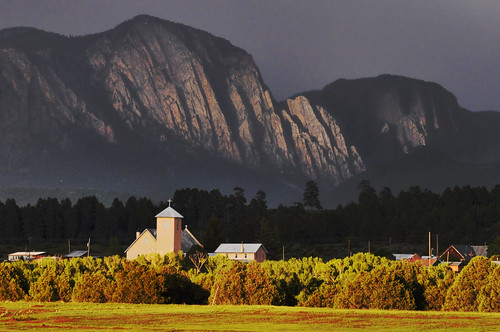
Now here's an interesting thought … how much is a view really worth? If that view in the proposed development is worth $650,000, then the view from Five O'Clock Somewhere ought to be worth at least a couple hundred thousand. And what about the San Jose Church in Los Ojos? What's that view worth?

Labels: , , , , , , ,

Friday, June 19, 2009

Animal rights?

Really, how far is too far?

So our President is now famous for swatting a fly.

This may be disappointing to those conservatives who wish to question his competence to be commander in chief, on the basis that he's going to be reluctant to use force as a means of influencing rogue governments. They can no longer use the saying, "He wouldn't hurt a fly" as an implication that he's averse to getting into a fight.

And of course, the comedians are having a lot of fun; late-night television is full of jokes and spoofs of the incident.

Meanwhile, People for the Ethical Treatment of Animals has weighed in: the President's act was one of unconscionable cruelty. Not only did he execute that innocent fly, he did it on international television, making a mockery of the creature's death. Worse, afterward, the camera zoomed in on the lifeless body, preventing it from having even the least modicum of dignity. And then the comedians swept in, making a mockery of the loss of this valuable living creature.

Now, I do value much of the work that PETA and other organizations do to protect animals from cruelty and wanton exploitation. Subjecting an animal to pain, and even death, simply for human entertainment, such as dog-fighting and bullfights, is barbaric. Bludgeoning baby seals to death, so those humans who are wealthy enough can purchase coats made from their extra-soft fur, is unconscionable. Raising calves in cramped, dark, dirty conditions so that their meat will be paler and more tender is unthinkable. I respect people who have chosen not to eat meat on moral grounds; they have decided that even humane methods of raising and slaughtering animals are cruelty that they do not wish to support, and I am glad that they take that stand. They raise consciousness even among those of us who do still eat meat.

But a fly?

I once saw a television documentary that was a countdown of the deadliest creatures on the planet. Guess who the winner was? No, it wasn't sharks or poisonous snakes or spiders. It was flies. Through history, the genus, which includes mosquitoes (Spanish for "little flies"), has been responsible for more deaths than any other. Malaria, sleeping sickness, dengue fever, West Nile virus, Ebola, E coli, rotavirus, the list of diseases carried by flies goes on and on. Fleas may have carried the bubonic plague that devastated Europe in the 14th century, but even with that, the flies have them beat.

I hope Obama grabbed the hand sanitizer after swatting that fly.

Labels: , ,

Thursday, May 14, 2009

Internet access blues

Whatever happened to all the incentives to get rural and low-income people onto the Net?

As I've chronicled here before, Pat's and my Internet access has been threatened by a battle between our little local ISP and the Big Bad Telecom company, and the Not-So-Big Not-So-Bad Regional Telecom company has also gotten snarled up in the battle, and so have a lot of other little ISPs and telecoms. Now our ISP has been divided up into at least two different divisions (both of whom had been sending us bills, and we thought maybe we had straightened out the situation, but now it seems the wrong one is the one that is getting our money), and that ISP is no longer providing service at Five O'Clock Somewhere.

The problem is compounded by new policies at the community college where I work. Even though the state legislature cut our funding and ordered us to raise tuition in order to make up for the funding cuts, our administration has chosen NOT to raise tuition, reasoning that in periods of financial hardship, the very last thing our students need is a tuition increase. The upshot of that decision is that a whole lot of expenses have to be cut elsewhere.

One of the areas in which we are to cut expenses is paper, and all of the person-hours it takes to handle said paper. No longer will there be paper grade sheets, on which we record students' homework, attendance, and other data. That will all now be on electronic spreadsheets. The burden of keeping records has been shifted to the instructors; the department will no longer maintain file drawers of paper grade sheets, so if a student protests a grade, the instructor's electronic spreadsheet will be requested.

(I consider that system to be flawed, since an instructor could easily alter the spreadsheet before submitting it to the administrator dealing with the protest; it would be much better for the instructor to submit a spreadsheet to be kept on file, just as the paper grade sheets have been kept, routinely at the end of the term. We want to keep the system honest. But that's just a digression from my main point.)

Anyhow, because of these changes in how things are done, I must now keep in contact with the college even when I'm not physically present. I might be able to be out of touch over a weekend, but I shouldn't go longer than two days without checking in. That means no more extended stays at Five O'Clock Somewhere unless I have Internet access.

But, since Pat is currently not working (or at least not working for money – he's been doing some great volunteer work for both the New Mexico and Rio Grande sailing clubs, and some stuff for the sailing folks in Arizona and elsewhere), we can't afford to pay any more for Internet access than we're currently paying, $20 a month (plus taxes) for dialup access.

Here is what we need: Internet access, both in Albuquerque and in northern Rio Arriba County (dialup will do), from a single provider, at a single price of $20 or less.

Here is what we have found: No land-based Internet provider serves both Albuquerque and northern Rio Arriba County. We can keep our existing ISP in Albuquerque for $20 a month, and pay another ISP another $20 a month for service at Five O'Clock Somewhere. We can ditch our land-line in Albuquerque and use our cell-phone provider for high-speed Internet, saving $20 a month on the land-line and $20 a month on what we pay our current ISP but adding $60 a month to the cell-phone bill, and cell signals don't reach Five O'Clock Somewhere, so we'd have to drive to somewhere there was a signal to access the Internet. We can get satellite-based Internet for about $50 a month that would be available anywhere, but right now, $50 a month would be a severe strain on our budget.

Here is what we have not found: Where the money is going that you get charged on your telephone bill that is supposed to subsidize Internet access for rural (e.g. Rio Arriba County) or low-income (e.g. AGI of $16,000) people. Yeah, look at your phone bill, your cell phone bill, your Internet bill … how much are you being charged in taxes that are supposed to be helping people like me and Pat? None of these ISPs make any mention of any way for rural or low-income people to apply for subsidies. We did find one ISP with a great discount for educators in Taos County, but that was just that ISP's special program, and it had nothing to do with the federal system.

An interesting thought … if you would rather not spend your money on these strange fees that you see on your telephone bill, you could send them to Five O'Clock Somewhere instead. I guarantee you that they will actually be used for what they claim to be for, Internet access for rural and low-income people. If some angel were to pay for satellite-based Internet, we would probably erect a shrine.

Labels: , , , ,

Tuesday, May 12, 2009

The weather was perfect

And not just on average!

This past weekend had its ups and downs. Saturday was the Joshua Slocum single-hand race, while Sunday was the Jack and Jill his-and-hers race. The plan was that I would be Principal Race Officer on Saturday, allowing Pat to sail Black Magic in the Slocum, and Pat would be PRO Sunday, so Zorro and I could defend our title in the Jack and Jill on Constellation.

The club has recently been given a small motorboat for use as a race committee support boat. It's old, it's been sitting in a back yard neglected for some years, and it needs some work. However, it is a basically sturdy boat, and it's already beginning to prove its worth (more on that in a moment).

Pyrat and Goldilocks, who donated the boat to the club, have been enthusiastic about getting it fixed up and outfitted as a race support boat. Goldilocks is an artist, and this project is giving her creativity a new outlet – the boat is developing a distinctive Sierra County feel. For example, instead of a bimini top, she found an inexpensive beach umbrella to put into the fishing-rod holder at the center of the boat. It's not good in higher winds, but it's distinctive; sailors can recognize the boat because it's the only one on the lake with a parasol.

Goldilocks was delighted to learn that I wanted to use the motorboat for race committee duty Saturday. The boat gives her an opportunity to support Pyrat's racing, but she wants to learn more about how things work, so she can be more help in the future. Pat had given her a notebook with procedures of running races, but she wanted some hands-on experience. Gerald, after finishing his college finals, had driven all night to join us at the lake; he came on board the motorboat as well.

To begin with, there was almost no wind on the lake. Since only one of the boats racing in the Slocum had a motor, we towed all the rest out to the race area. Score one for the motorboat. Once we got to the race starting area, we did have to wait for wind, but because all the racers were there, we could start a race immediately when the wind did come up.

Just as the wind came up, Pyrat's MC Scow capsized, and although he got the boat upright, he wasn't able to get himself back up onto the boat. Compounding the problem was that he hadn't completely buckled up his PFD, and he was gradually slipping out beneath it. We zoomed to the rescue, deploying the motorboat's boarding ladder so Pyrat could get aboard and then onto his own boat. Score another one for the motorboat. Goldilocks thought maybe we should then tow Pyrat to shore, but he assured her he was all right and could keep sailing. With the temperature in the 90s, there wasn't much worry about hypothermia, so he finally persuaded her to let him sail.

We then set a starting line and called a course, and Goldilocks got to learn about how to run a starting sequence, with timing, flags, horn signals, and such. Pat even provided an extra learning experience when he had Black Magic over the line early, so she learned about recall procedures. She already knew that we should have fishing-rod holders on the boat to hold flags; now she knows how many we need and where they should go, and she's eager to get to work on that project. This boat had originally been abandoned in the back yard by the previous owner when she and Pyrat bought their house; now, instead of a decaying eyesore, it's a fun project. Score yet another one for the motorboat, although this one is more about personal fulfillment than sailing regatta duties.

When the wind came up, it did so nicely. Conditions were perhaps a bit on the stiff side for single-handed racing, but all of the racers handled it well. The motorboat's anchor – another great find that Goldilocks had come by – held well. By the time the race finished, the wind was beginning to scream. Gerald, at the helm, cranked the motor up and we roared back to the boat ramp, getting somewhat wet in the process, but glad we had a way to get back to port quickly. Score another biggie for the motorboat.

Sunday's weather shaped up similar to Saturday's, calm to start with winds showing up around midday and increasing – the main difference was that the temperature was about ten degrees warmer.

Zorro had had to go back to El Paso the night before for a special event at UTEP, but he had told us that he planned to return in the morning so he and I could sail in the Jack and Jill. Cornhusker had talked Bassmaster into being crew on her boat for the race, so I rode with them to the marina where both her boat and Zorro's are docked, while Pat and Gerald went to the other marina, where the motorboat lives. It had taken Bassmaster some time to get his stuff together, so I was worried about being late to meet Zorro. It turns out I didn't need to worry; there was no sign of him.

So, while other sailors got ready and set sail for the Jack and Jill, I waited for Zorro. I tried calling him, but the call went straight to his voice-mail.

Meanwhile, Pat and Gerald got the motorboat out to the race start area, but then the motor died. Yoda was preparing to sail the race with Esther; he got onto the motorboat to see if he could do something with the motor. He came to the conclusion that probably there was a problem with the carburetor, such as a stuck valve – as old as that motor is, it has a lot of, to use a technical term, gunk in it.

When it became obvious that Zorro wasn't going to show up, one of the other racing boats, Cultural Infidel, came to the marina to pick me up, so I wouldn't be roasting in the sun at the marina all day with no boat to ride, no money, and no vehicle, as Cornhusker and Bassmaster had given me a ride to the marina. We got to the course while Yoda was still working on the motor; eventually, he and Gerald managed to get the motor to where it would run, sort of, and then he got back on Esther's boat and I got onto the committee boat.

As on Saturday, we had to wait for the wind, but when it arrived, it came in nicely. If Zorro had showed up, he and I would have had a great afternoon on the water, with wind that remained mostly steady, a little on the light side but not frustratingly so, with some gusts to make things interesting.

While the wind was far from frustrating, the fact that I was sitting on an anchored motorboat instead of out sailing in the race was more than frustrating. I was watching my bucket go away. The trophy for the Jack and Jill race is, appropriately, a pail. The tradition is that each year, the previous year's winners provide a bottle of champagne to put into that pail, along with ice, for the new champions. The past few years, Zorro and I have simply been buying ourselves champagne every year (he likes pink). But Sunday, I was left to watch and see who Zorro and I would be buying the champagne for this year.

Cultural Infidel was first over the line. However, Esther and Yoda on Hot Flash were right behind and won the race on corrected time. So they will get the champagne and custody of the bucket. However, since Team Infidel came to my rescue, I plan to buy them a bottle of bubbly as well.

Once the race was over, it was time to start the motor and get back to the boat ramp. The motor ran rough, and it wouldn't put out much power, but it did get us there, stalling out just as we reached the courtesy dock. Gerald was able to paddle the boat onto its trailer. We'll be having one of the mechanically inclined members of the club look at that carburetor; it shouldn't be too hard to fix.

Meanwhile, the question remained … where was Zorro?

Late Monday, we finally heard the story. After the event at UTEP, instead of going home to rest up and prepare for the Jack and Jill, Zorro decided to pay a visit to his new girlfriend in Juarez. I have my doubts about this particular girlfriend, but then, well, he's in love (or at least thinks he is), and there's nothing I could say that would change his mind. Still, the decision to go and visit her wasn't exactly wise; while he was there, somebody slashed the tires on his car.

So, because of the slashed tires, Zorro didn't make it to the Jack and Jill race. It would have been nice if he could have phoned or otherwise communicated, so I could have made other arrangements. Penzance was at the lake, working on his boat, and he and I could have sailed Black Magic. Or Pat could have done committee boat duty solo and I could have had Gerald as crew. Or I could have twisted Teddy Bear's arm – he's regaining confidence about racing after recovering from some health problems, and Sunday's relatively gentle conditions would have been just right to take Warm N Fuzzy out.

But since I didn't hear from Zorro, I never got a chance to make other arrangements. Later, when Pat brought up that issue, Zorro claimed that his cell phone wasn't working, so he had told one person to give a message to another person to give a message to me – and both of the persons in that chain are not known for being reliable, and neither of them is particularly interested in sailboat racing or the Jack and Jill race or anything of the sort. I strongly suspect Zorro never gave the message in the first place, and he's blaming those other persons for my not receiving it to avoid taking any blame himself. But even if he did give the message, he should have known that the likelihood of my getting it was remote. He knows my cell phone is set to take his calls as high-priority 24/7. And even if I were asleep and not answering the phone, he could have left a voicemail that I would have gotten as soon as I woke up Sunday morning.

Final report on the weekend:

Motorboat for race support: big thumbs up, especially when we get the carburetor fixed and additional flag holders in place. And Goldilocks has other improvements in mind – those are going to be fun to see.

Zorro: thumbs down for leaving me high and VERY dry on the dock. Yeah, I can be sympathetic about the slashed tires. But he definitely could have done a much better job of communicating so I could have made other arrangements. I could be enjoying that champagne with Penzance, Gerald, Teddy Bear, or somebody else.

Labels: , , , , , , ,

Thursday, April 30, 2009

Swine flu and The Cough That Will Not Go Away

I am still suffering lingering after-effects from the cold or flu that I had five weeks ago. While most of the symptoms have gone away, I still suffer from The Cough That Will Not Go Away. It nags at me, giving me coughing fits that make my ribs ache. It keeps me from sleeping at night. At times, it's so severe that it upsets my stomach, and it often causes incontinence.

I know from past experience that when I get The Cough, what makes it go away is the cough medicine that has codeine in it. For some reason, the codeine shuts down the cough, and in only 24 hours, The Cough is gone.

Officially, the medicine with the codeine is over-the-counter, but with restrictions, so the person getting such medicine must sign for it and provide identification. In practice, no reputable pharmacy wants to provide this medication to anybody who doesn't have a prescription. There's too much risk of providing something addictive to people who are addicted.

Since I don't have medical insurance, it would cost me an arm and a leg to go to a doctor to get a prescription. And since I don't have any money to pay for a doctor visit, I have no way of getting a prescription for the medication that will work.

I wonder what would have happened if the current swine flu outbreak in Mexico had happened five weeks ago, at the same time as my flu symptoms were at their peak. Would I have been forced into a treatment program, regardless of my ability to pay for it? Would I have been forced to abandon my students, either to a substitute instructor who wasn't up on what my classes were doing, or to not having class at all?

My latest success in alleviating The Cough has been herbal tea based on Ayurvedic healing principles. This tea has been especially effective at easing chest congestion. It's not perfect, but at least it lets me sleep at night.

Labels: ,

Saturday, January 31, 2009

Assault on apostrophes

It may be only a little piece 0f punctuation, but it means a lot

I have just heard of an alarming development in the world of those of us who care about grammar, punctuation, and the correct application of such concepts.

The city of Birmingham, England, has declared a ban on the use of possessive apostrophes on municipal street signs. Rather than try to use the punctuation mark correctly, the city council has decided just not to use it at all.

First, let's have a quick review of how apostrophes are to be used. They are used in contractions, when letters have been left out of a word or words, often when words have been run together. For example, the phrase do not can be contracted into don't, in which the missing o is replaced by an apostrophe.

The other major use of apostrophes is in forming possessives, and apparently it's that usage that has led the city fathers of Birmingham to give up. I will admit that some grammar textbooks make this construction unnecessarily complicated. For all practical purposes, there is only one rule that suffices when forming a possessive: Does the word being made into a possessive end in s? If it does not end in s, you add 's; if it does end in s, you just add '. That's all you need to know.

Some grammar handbooks will add more complications, such as whether it's the proper name of somebody and whether it's singular but the pronunciation doesn't change, or whether it's the name of somebody famous like Jesus or Moses, but that's all just making things more complicated than they need to be. If you just follow the rule of s vs. no s, you'll be all right. My suspicion is that the Birmingham town council has been confused by all of those way-too-complicated rules and just gave up.

Now, there are some important rules for when NOT to use apostrophes as well. Apostrophes should never, ever be used for plurals or for the -s form of verbs. It's two horses, not two horse's. And apostrophes aren't to be used for possessive pronouns, to avoid confusion with contractions. If it can be spelled out, it's a contraction and uses an apostrophe, but if it can't be spelled out, it's not a contraction and therefore doesn't use an apostrophe. You can't say "The kitten chased it is tail," so you know you have to use its without the apostrophe.

Back some years ago when I worked at the sports desk of a major newspaper, some of the reporters there had difficulty with such constructions as girls' basketball, so the decision was made to do away with the apostrophe. I could make a justification for that decision on the basis that the construction was not a possessive; it was a noun used as an adjective. Thus the apostrophe wasn't needed.

However, for consistency's sake, that meant that when covering the university basketball teams, we should also have used not the possessive, but the noun used as an adjective, women basketball and men basketball. That didn't fly. To this day, the newspaper uses possessives for university sports but nouns as adjectives for high school. I would argue that such a double standard short-changes high-school athletes, who deserve possessives just as much as college athletes do.

Labels: , ,

Wednesday, January 14, 2009

Sailing update and telecommunications ups and downs

No, I’m not dead, and I haven’t deserted the blogosphere either.

With the beginning of a new term this week, I’ve been busy with getting my classes going, syllabi distributed, class homepages established, and of course the extra paperwork that happens both at the beginning and at the end of the term. The paperwork, which is now mostly paperless, has been complicated this term by the department’s website being relocated to a new server – the old server was becoming increasingly unreliable, but the new system on the new server doesn’t support some of the features of the old website.

Yes, Pat and Gerald and I did go sailing with Zorro this past weekend. It wasn’t quite a replay of the previous weekend, in that the winds were lighter. Still, we got in some really good sailing. Friday we got to the lake about a half-hour before Zorro did, so we had enough time to get the boat rigged and turned around in the slip just in time for Zorro to arrive, hop aboard, and set sail. Again, we sailed up into the northern portion of the lake, although with less wind we didn’t get as far as the previous weekend before we turned around to come back in the golden glow of the sinking sun. The sun set as we were coming around Long Point, with the stunning range of colors, gold to red to purple, glowing on the mountains east of the lake, enriching the multicolored hues of the desert. Then as daylight faded, we had the brilliant glow of the full moon by which to finish our sail.

Dino was at the lake, although he wasn’t sailing. He and one of his workers were making repairs to a couple of his rental properties, and he was also looking at additional houses to buy. I had work to do in Albuquerque to prepare for the school term, so we left Gerald with Dino and returned home.

Saturday, I got much, but not all, of the work done that I needed to do – there were some things that I couldn’t do online, so those would have to wait until Monday when I got into the office. Meanwhile, Gerald was learning something about the landlord business, helping Dino. One of his tenants had died, and the tenant’s daughter had taken away the water heater but nothing else, leaving a house full of really nasty garbage, as well as some torn-up pipes where the water heater had been. They had to call in a hazardous-waste disposal company from El Paso to deal with the garbage, since nobody in Sierra County could handle the job, and they also had to install a new water heater.

Saturday night we returned to the lake. Sister Rosebia and Skater had arrived, as well as Dino’s brother, his wife, and their two small children, so it was a full house.

Sunday morning, Pat and I went out sailing with Zorro again. The winds this time were light, so we didn’t try to go to the far end of the lake. By mid-afternoon, the winds had died, so we drifted back to the dock, retrieved Gerald from Dino’s house, and went to lunch while waiting to see whether the wind would come back. It did, a little bit. However, Gerald and I both had to get back to Albuquerque, so we helped Zorro set sail. As we were leaving the marina, we could see him, sitting in the water about a hundred yards out, completely becalmed. Oh, well. At least it was nice and sunny, and warm.

So for those of you out in the blogosphere who are keeping count, so far this year, Pat and Zorro have had five sailing days, while I have had four and Gerald has had three.

Meanwhile, the electronically connected world has been giving us its own problems. We get Internet services from a small, locally based company – it’s slow, but it’s cheap. About three months ago, this local company merged with two other companies to become a subsidiary of one of them. The new company is still small, however, compared to the big telecommunications company that dominates this part of the U.S.

The problem is that the big company and the small company have been having disagreements. The small company leases services and equipment from the big company and then provides the same services to customers that the big company provides, but it charges a considerably lower price. The big company says that’s unfair competition, and it also says the small company is behind on paying its bills. So on New Year’s Eve, without any warning to the customers, the big company cut off services to all of the small company’s customers, including several hospitals, small-town 911 operations, and similar critical services. The state Public Regulation Commission had an emergency meeting on New Year’s Day and ordered the big company to restore services, but the big company said that couldn’t be done all right away. Pat and I were lucky in that we got our services back immediately, but many other customers have had to wait more than a week.

Meanwhile, we’ve been getting sales pitches from the big company offering to “let” us switch to that company’s services, as it is “more reliable” than our existing service provider. Let’s see … the big company caused the little company’s services to go out, and now it cites the little company’s unreliability as a reason to switch. Anybody see something suspicious here?

State regulators are now saying that both companies are to blame, but the big company is much more at fault. The little company should have given its customers some warning of the problems it was having with the big company – for that matter, it occurs to me, the little company should have told our company something about the problems at the time of the merger. Meanwhile, the big company appears to have been engaging in unfair and possibly fraudulent billing, as well as anti-competitive practices and violating a previous court order forbidding it to cut off services to the little companies that lease and re-sell services from them.

At least on the cell phone front, things are looking much better. My old cell phone was dying, and I discovered that I was eligible for a free upgrade; meanwhile, we finally got Pat his own phone. Even though my new phone is as no-frills as cell phones get nowadays, it still has some nifty features that I’m having fun with, like using Bluetooth to transfer things from my computer’s iTunes library to use as ringtones. Pat’s new phone has even more fun features, although it may take him some time to learn to use them – he’s still at a rather primitive stage of cell phone knowledge.

Labels: , , , , , , , , , , , , ,